- English
- French
- German
- Portuguese
- Spanish
- Russian
- Japanese
- Korean
- Arabic
- Greek
- German
- Turkish
- Italian
- Danish
- Romanian
- Indonesian
- Czech
- Afrikaans
- Swedish
- Polish
- Basque
- Catalan
- Esperanto
- Hindi
- Lao
- Albanian
- Amharic
- Armenian
- Azerbaijani
- Belarusian
- Bengali
- Bosnian
- Bulgarian
- Cebuano
- Chichewa
- Corsican
- Croatian
- Dutch
- Estonian
- Filipino
- Finnish
- Frisian
- Galician
- Georgian
- Gujarati
- Haitian
- Hausa
- Hawaiian
- Hebrew
- Hmong
- Hungarian
- Icelandic
- Igbo
- Javanese
- Kannada
- Kazakh
- Khmer
- Kurdish
- Kyrgyz
- Latin
- Latvian
- Lithuanian
- Luxembou..
- Macedonian
- Malagasy
- Malay
- Malayalam
- Maltese
- Maori
- Marathi
- Mongolian
- Burmese
- Nepali
- Norwegian
- Pashto
- Persian
- Punjabi
- Serbian
- Sesotho
- Sinhala
- Slovak
- Slovenian
- Somali
- Samoan
- Scots Gaelic
- Shona
- Sindhi
- Sundanese
- Swahili
- Tajik
- Tamil
- Telugu
- Thai
- Ukrainian
- Urdu
- Uzbek
- Vietnamese
- Welsh
- Xhosa
- Yiddish
- Yoruba
- Zulu
What Is Anodized Titanium? Colors, Uses, and How It Applies to Your Parts
What Is Anodized Titanium?
Anodized titanium is titanium whose natural oxide film has been thickened and structured by an electrochemical process until it produces a controlled color or an engineered surface property. Bare titanium is never truly bare: within seconds of exposure to air it forms a natural oxide layer roughly 1.5 to 10 nanometers thick, and it is that film which gives titanium its corrosion resistance. Anodizing takes over where the natural film stops, growing the oxide deliberately at a nearly constant rate of about 1.6 to 2.0 nanometers per volt, so that a 10 V bath builds a pale gold film, 25 to 40 V builds blue, and voltages toward 100 V and above push the film past 150 nanometers into green and pink tones. Because the color comes from light interference inside a transparent oxide, not from a dye, the finish cannot peel, flake or wash out.
People who ask what is anodizing titanium or what is titanium anodizing are describing the same process. The name comes from the electrical arrangement: the titanium workpiece is connected as the anode, the positive electrode, in an electrolytic cell, while a counter-electrode completes the circuit. It is the same basic electrochemistry, run at industrial scale, that this site's core product line is built around.
The Oxide Science Behind the Color
The color sequence is governed by thin-film interference. Incident light reflects from both the outer oxide surface and the oxide-metal interface; when the two reflections recombine, some wavelengths cancel and others reinforce, and the surviving wavelengths are what the eye sees. Film thickness therefore selects the color: roughly 25 nanometers reads as yellow, around 40 nanometers as blue, and films near 160 nanometers shift toward green. Academic work on barrier-film growth, including Kang et al. (Materials Characterization, 2017), confirms the growth is linear at roughly 1.9 to 2.1 nanometers per volt in alkaline electrolytes, which is why a voltage chart, once calibrated to a given grade and electrolyte, is repeatable enough for production.
The same titanium-oxide chemistry does industrial work beyond decorative finishes. Dimensionally stable anodes, the coated titanium electrodes that transformed the chlor-alkali industry after Henri Beer's 1965 patent, carry an electroactive oxide layer of ruthenium and titanium oxides on a titanium substrate. Beer's innovation replaced graphite electrodes that dissolved and drifted apart during electrolysis with electrodes that hold their shape because the oxide layer is engineered into the surface, the way an anodic film is engineered into anodized titanium. That lineage, documented in reviews such as Duby's history of dimensionally stable anodes in JOM (1993), is why a mill that coats titanium electrodes is a natural authority on titanium oxide surfaces in general.
Standards That Define Anodized Titanium
Buyers who need more than a color specify the finish by standard. ASTM B580 covers anodic oxide coatings on titanium, and AMS 2488, the aerospace specification for anodic treatment of titanium and titanium alloys, divides the work into types. Type 1 anodizing produces a dimensional increase of 0.0002 to 0.0004 inch (5 to 10 micrometers) per surface and is used as an anti-galling treatment; Type 2 provides an anti-galling film without additional lubrication; Type 3 is color anodizing used for part identification and appearance. Understanding which type your product requires determines the process, the inspection method and the documentation, and it keeps a decorative finish from being ordered where a functional one is needed.
Where Anodized Titanium Is Used
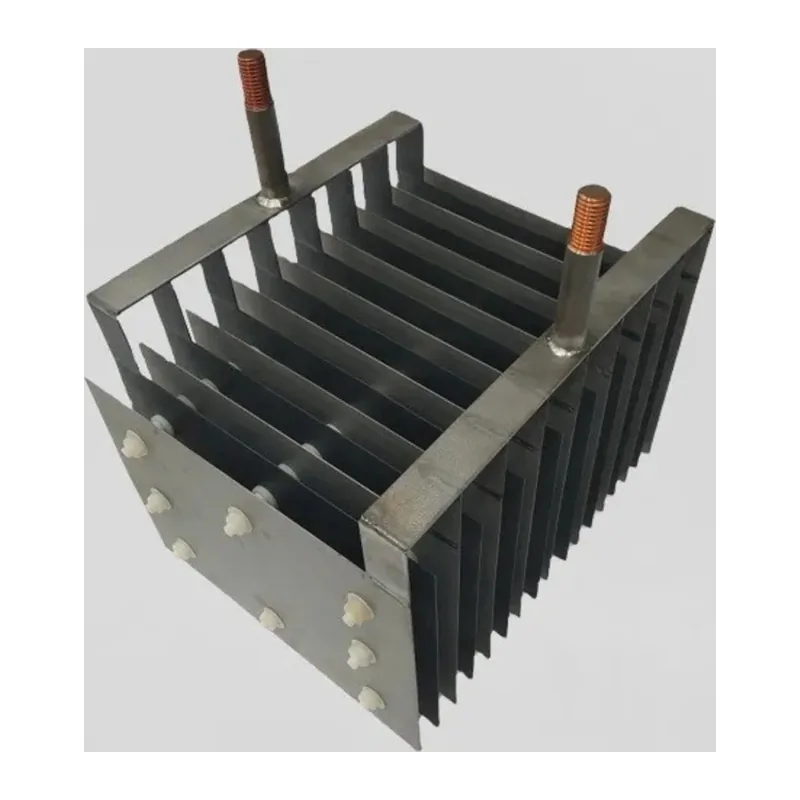
Decorative color anodizing appears in consumer products, jewelry, piercings, knives and EDC gear. Functional anodizing protects fasteners from galling, colors and codes medical implants and surgical instruments, and passivates aerospace parts. The same oxide-science toolkit, scaled to electrolysis cells, is what MMO-coated titanium anodes do in electroplating, water treatment, chlor-alkali production and cathodic protection: an oxide layer on titanium, engineered to a specification, doing electrical and chemical work instead of optical work.
What to Specify When You Buy Titanium
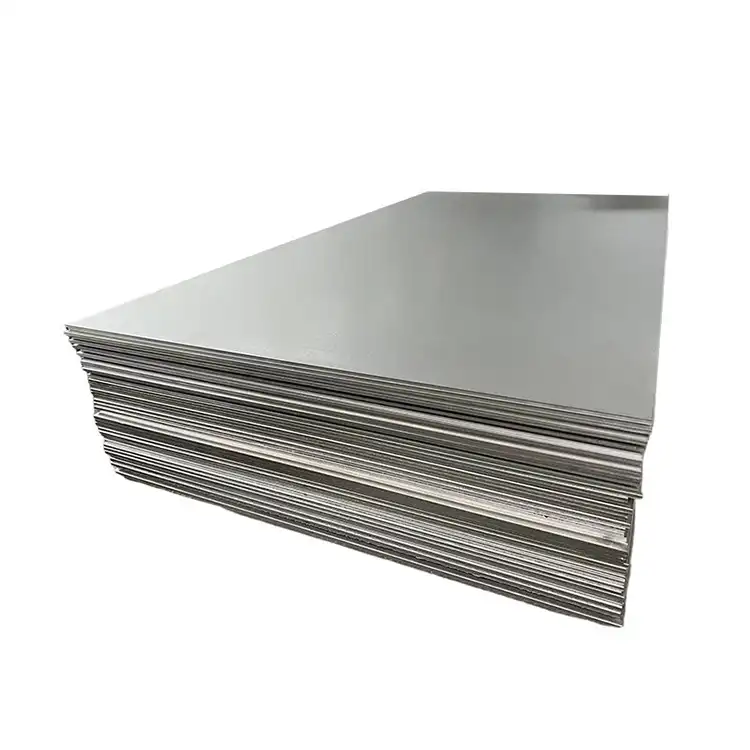
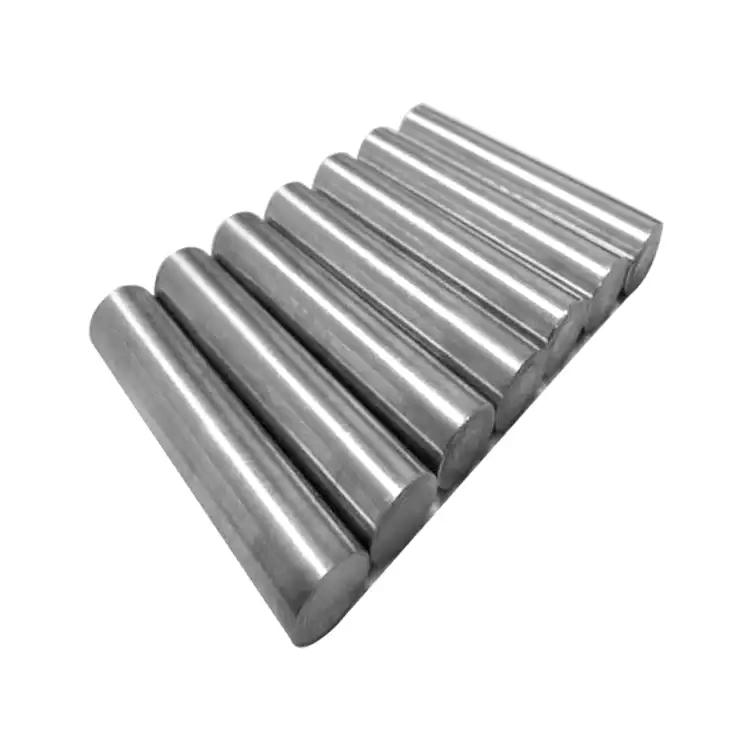
Three variables decide the finished result: grade, surface finish and voltage. Commercially pure grades anodize to the familiar full color spectrum, while alloy grades such as Ti-6Al-4V shift the sequence and produce less saturated color at the same voltage. A polished surface reflects more light and reads brighter than a bead-blasted one at identical settings. If a product line must hold a house color, lock the grade, the finish and the voltage program together, and change none of them without a qualification sample. HYTi supplies titanium sheet, plate, rod and wire with mill certificates, cut to blank size, so the substrate your anodizing line processes is the same batch after batch.
Testing, Documentation and Consistency
For production buyers the certificate is part of the product. We provide mill test certificates for composition and mechanical properties against the applicable ASTM specification, and we can add dimensional reports on cut blanks and surface roughness records where color consistency depends on finish. On the electrode side of our business, coating uniformity and composition are controlled and documented the same way, because an oxide or mixed-oxide layer is only as repeatable as the process that grew it.
Frequently Asked Questions
Does anodizing titanium add thickness? Yes, but almost none in decorative work. Color films are measured in tens to a few hundred nanometers. Functional Type 1 anti-galling films add 5 to 10 micrometers per surface, which is exactly why AMS 2488 specifies a dimensional increase to be measured before and after processing.
Does anodized titanium contain nickel? The anodic film is titanium oxide and contains no nickel. Nickel content, if any, comes from the alloy grade under the film, so confirm the grade certificate for nickel-sensitive products.
Why anodize titanium instead of painting it? Paint sits on the surface and can peel; an anodic film is grown out of the metal itself. It cannot flake, adds no separate coating layer, and leaves the part recyclable and biocompatible.
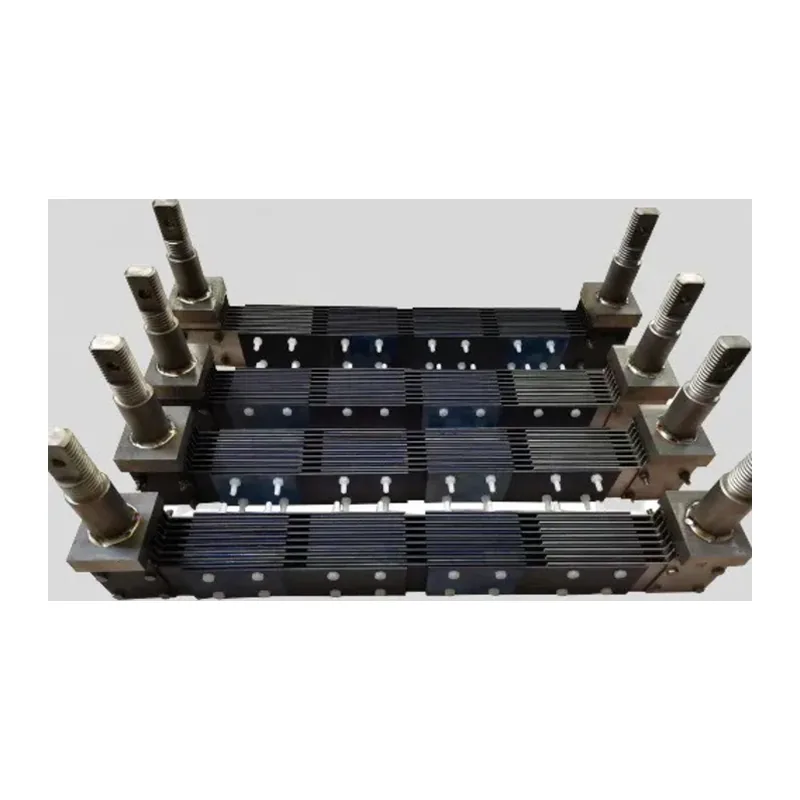
Can titanium be used as a catalyst or an anode? Yes, and this is titanium oxide technology at its largest scale. Coated titanium anodes, such as the MMO anodes HYTi manufactures, use a ruthenium-iridium or iridium-tantalum oxide layer on a titanium substrate to drive chlorine evolution, oxygen evolution and other electrochemical reactions for years of continuous service.
From Anodized Parts to Industrial Anodes
If your interest in anodized titanium comes from running an anodizing, plating or electrolysis line, HYTi supplies the industrial side of the same chemistry: MMO-coated titanium anodes, platinum-coated and iridium-tantalum anodes, anode baskets and auxiliary anodes built to drawing. Send your process, electrolyte, current density and dimensions, and we will recommend the right coating and configuration.
Request a Quotation
Tell us the grade, thickness, surface finish, dimensions and quantity of titanium you need, or the process and anode geometry if you are specifying electrodes. Contact our sales team at jolina@bjhyti.com and we will respond with recommendations, sample options, price and delivery terms.
References
P. Duby, The history of progress in dimensionally stable anodes, JOM (1993): https://link.springer.com/article/10.1007/BF03222350
X. Fu et al., What insights can we learn from dimensionally stable anodes? Carbon Future (2024): https://www.sciopen.com/article/10.26599/CF.2024.9200027
Z. Zhang et al., A reflection on sustainable anode materials for electrochemical chloride oxidation, Advanced Materials (2023): https://advanced.onlinelibrary.wiley.com/doi/10.1002/adma.202300429
SAE AMS 2488, Anodic treatment of titanium and titanium alloys: https://www.sae.org/standards/content/ams2488b-anodic-treatment-titanium-titanium-alloys
Kang et al., Titanium anodizing oxide growth study, Materials Characterization (2017), as cited in titanium anodizing color guides: https://hontitan.com/titanium-anodizing-guide-voltage-chart
Titanium anodizing voltage and color chart guide: https://partmfg.com/titanium-anodizing-color-chart
Xometry, How to anodize titanium: https://xometry.com/resources/machining/titanium-anodizing
_1781504214411.jpg)
Learn about our latest products and discounts through SMS or email